

How to Prioritize Testing When Deadlines Are Tight
🕛 Introduction
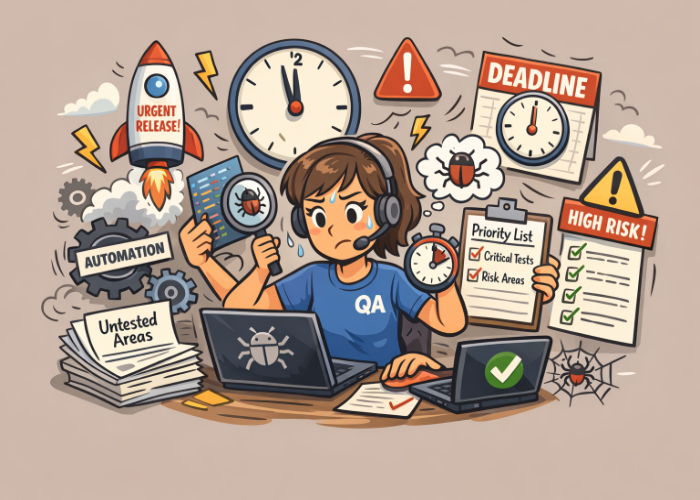
Tight deadlines are a reality in modern software delivery. Whether it’s a last-minute feature request, a production hotfix, a regulatory update, or a release date that simply can’t move, QA teams are often expected to deliver meaningful test coverage in far less time than they’d like.
The challenge isn’t just testing faster — it’s testing smarter.
This guide outlines a practical, structured approach to prioritizing QA efforts when time is limited, while still protecting product quality, business goals, and team morale.
🎯 Start With Risk-Based Testing
When time is constrained, risk becomes your decision-making framework.
Risk in testing is typically evaluated using two key dimensions:
- Impact – What happens if this fails? (Revenue loss, legal exposure, customer churn, brand damage)
- Likelihood – How likely is it to fail? (New code, complex logic, history of defects)
A simple formula often used:
Risk = Impact × Likelihood
Focus first on areas that are both high-impact and high-likelihood.
High-Risk Areas Commonly Include:
- Customer-facing core functionality
- Revenue-related workflows (e.g., checkout, billing)
- Security-related features (authentication, authorization)
- Data processing and data integrity logic
- Recently modified or newly developed features
- Complex integrations (third-party APIs, payment gateways, external systems)
Ask yourself:
If this breaks in production, who feels it—and how severely?
That answer should guide your priorities.
🧩 Define Must-Test vs. Should-Test vs. Could-Test
When everything feels urgent, categorization brings clarity.
✅ Must-Test (Critical Path)
These protect the fundamental purpose of the product:
- Core user workflows
- End-to-end primary journeys
- Payment or transaction flows
- Data creation, update, and deletion logic
- Security validation
- High-risk bug fixes
- Compliance-related functionality
If these fail, the release likely cannot proceed.
⚠️ Should-Test (Important but Not Blocking)
- Secondary features
- Common edge cases
- Major browser/device combinations
- Performance sanity checks
- Reporting features
These are important, but may be deferred if time expires.
💤 Could-Test (Nice to Have)
- Cosmetic UI inconsistencies
- Rarely used paths
- Minor usability refinements
- Low-impact configuration variations
Being transparent about these categories prevents scope creep disguised as “just one quick test.”
⚡ Use the Fastest Feedback Loops First
Under pressure, prioritize high-signal, low-effort testing techniques.
1️⃣ Smoke Testing
Run a focused smoke suite to confirm:
- The application launches
- Core workflows execute
- No critical blocking defects exist
This quickly answers: Is this build even testable?
2️⃣ Automation (Where It’s Stable)
If you already have:
- Stable regression suites
- Reliable API tests
- CI-integrated test pipelines
Use them.
Automation provides rapid confidence across known high-risk areas — but avoid rushing to create new automation under severe time pressure unless absolutely necessary.
3️⃣ API Testing Over UI Testing
Where possible:
- Validate business logic at the API layer.
- Confirm response codes, payload structures, and data integrity.
API testing is typically faster, more stable, and less brittle than UI testing.
4️⃣ Focused Exploratory Testing
Exploratory testing is especially powerful when deadlines are tight.
Instead of broad unscripted testing, apply charter-based exploration, such as:
- “Break the checkout flow.”
- “Stress error handling for invalid input.”
- “Test boundary values for pricing calculations.”
This approach uncovers high-severity issues quickly without heavy documentation overhead.
🔄 Prioritize the Core End-to-End User Journey
Even if you cannot test every branch or edge case, you must validate the primary user value path.
Examples:
- Account creation → login → main action
- Search → select → purchase
- Upload → process → retrieve result
If the product’s central purpose fails, no amount of minor fixes will compensate.
End-to-end validation of the core journey is non-negotiable.
📉 Reduce Redundant Testing
Under time pressure, avoid:
- Retesting unchanged areas without reason
- Full regression cycles when only a small module changed
- Repeating low-risk tests out of habit
Instead:
- Use change impact analysis.
- Ask developers what files or modules were modified.
- Target regression accordingly.
Smart scoping preserves time for high-risk validation.
🤝 Collaborate Closely With the Team
Testing under tight deadlines is a team sport.
Sync With Developers
- What changed?
- What concerns them?
- Where do they feel risk exists?
Developers often know fragile areas.
Align With Product Owners
- What absolutely must work for release?
- What can be deferred?
- What is customer-visible vs. internal?
Clear alignment prevents unrealistic expectations.
Communicate Findings in Real Time
Instead of waiting for a formal test cycle to end:
- Share critical defects immediately.
- Provide quick risk summaries.
- Update stakeholders on testing scope adjustments.
Fast feedback reduces rework and prevents surprises.
📊 Document What Was Not Tested (Risk Transparency)
When time compresses, untested areas become known risks.
Document:
- What was deprioritized
- Why it was deprioritized
- Potential impact
- Recommended follow-up
This protects the QA team and provides:
- Release transparency
- Audit traceability
- Input for the next regression cycle
A simple risk summary in the release notes can significantly improve stakeholder confidence.
🧠 Avoid Burnout-Driven Decisions
Tight deadlines often create pressure to:
- Skip documentation entirely
- Ignore defect severity distinctions
- Rush sign-off decisions
Instead:
- Stay structured.
- Apply consistent severity definitions.
- Make risk-based decisions—not emotional ones.
A calm, systematic approach prevents high-impact oversights.
🏁 Final Thoughts
Tight deadlines are inevitable in modern software delivery—but chaotic testing doesn’t have to be.
When time is limited, success comes from discipline and clarity:
- Prioritize based on risk, not habit
- Protect the core user journey
- Use the fastest feedback mechanisms available
- Collaborate closely with development and product teams
- Document residual risks transparently
Effective QA under pressure is not about cutting corners. It’s about making informed trade-offs and ensuring the most critical aspects of the product are protected.
Every release carries some level of risk. The role of QA is not to eliminate all risk—that’s rarely possible under tight timelines—but to identify, evaluate, and clearly communicate it.
When you focus on impact, stay structured, and maintain transparency, you transform tight deadlines from a crisis into a controlled, strategic challenge.
Quality is not defined by how much you test.
It’s defined by how well you prioritize.




🗨️ Reader Comments