

AI Testing for QA Teams: How to Test AI-Powered Features Effectively
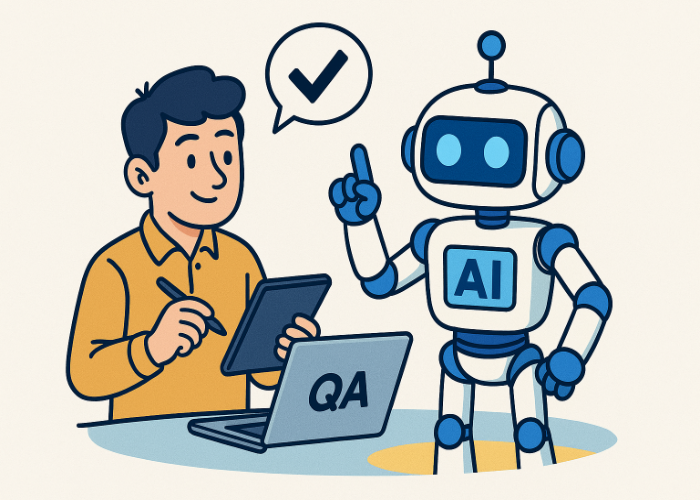
Why QA Must Evolve for AI
Artificial intelligence is no longer a future trend—it’s already transforming the apps we use daily. From search engines and product recommendations to fraud detection and customer support, AI is everywhere.
For QA teams, this means traditional testing methods alone aren’t enough. AI introduces unpredictability, continuous change, and ethical considerations that require a new approach to quality assurance. In this guide, we’ll explore how QA teams can effectively test AI-powered features, with actionable steps for every stage of the process.
Why Traditional QA Fails for AI Features
Classic QA focuses on predictable inputs and a single expected output. AI breaks this model:
- Recommendation engines can suggest different but relevant items each time.
- Chatbots may phrase answers in multiple valid ways.
- Fraud detection systems may produce varying risk scores as new data comes in.
The takeaway: QA must shift from seeking exact results to defining acceptable output ranges and monitoring trends over time.
How to Define Acceptable Output Ranges for AI Systems
AI testing relies on flexibility. Here’s how to set boundaries for what counts as “correct”:
- Identify variability: Determine which outputs are acceptable for different inputs.
- Set thresholds: Define statistical ranges for numerical outputs, relevance scores, or risk levels.
- Monitor drift: Track changes over time to catch subtle regressions.
- Use probabilistic testing: Apply pass/fail rules based on likelihoods rather than exact matches.
How to Ensure Data Quality in AI Testing
AI systems are only as good as the data they’re trained on. QA teams should treat data testing as part of QA, with these steps:
- Audit data coverage: Ensure all user groups and edge cases are represented.
- Check labeling accuracy: Verify that human-labeled samples are consistent and reliable.
- Validate data freshness: Confirm the model is trained on up-to-date patterns.
- Detect leakage risks: Make sure sensitive or irrelevant information isn’t included.
Step-by-Step: Building Adaptive Test Suites for AI
AI models evolve constantly. Your test suite must evolve too.
- Dynamic test sets: Update test data with new real-world inputs.
- Shadow testing: Run old and new models in parallel to compare outputs.
- Canary releases: Deploy AI features to a small subset of users first.
- Continuous monitoring: Track post-deployment performance to detect anomalies.
Ensuring Ethical AI: What QA Teams Must Do
Modern QA isn’t just about correctness; it’s about responsible AI. Testers should verify:
- Fairness: The model does not discriminate against any user group.
- Explainability: Decisions can be explained and traced.
- Safety: Outputs do not cause harm or produce inappropriate content.
- Compliance: Systems adhere to regulations and industry standards.
How to Leverage AI for Smarter QA Testing
QA teams can use AI as a testing assistant to scale and improve effectiveness:
- Generate large-scale, realistic test data automatically.
- Simulate user behavior at scale to identify edge cases.
- Detect anomalies and patterns that might be missed by humans.
- Automate exploratory testing to accelerate feedback cycles.
Best practice: Combine human expertise with AI-powered tools for maximum impact.
Collaborating Across Teams for AI QA Success
AI QA requires strong collaboration among multiple teams:
- Data scientists for model insights.
- Machine learning engineers for feature updates.
- Product owners for business context.
- Security teams for compliance and privacy concerns.
QA acts as the central hub, ensuring the AI lifecycle is reliable, responsible, and aligned with business goals.
Key Takeaways for QA Teams
AI is reshaping software, and QA must adapt. Successful testers in this era:
- Embrace uncertainty and variability in AI outputs.
- Think in a data-centric way.
- Implement continuous monitoring to catch issues early.
- Collaborate across disciplines for ethical and effective outcomes.
- Treat AI as both the product and a partner in testing.
The future of QA is here. Teams that combine human judgment with AI tools will be best positioned to ensure quality, fairness, and reliability in AI-powered software.



🗨️ Reader Comments