

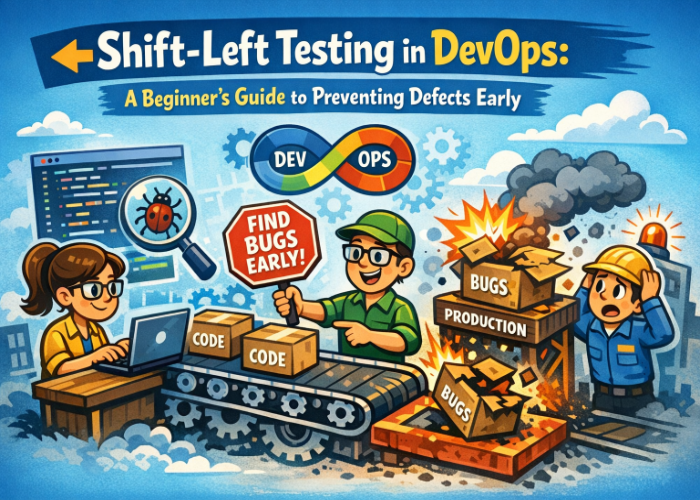
Shift-Left Testing in DevOps: A Beginner’s Guide to Preventing Defects Early
Introduction
In today’s fast‑paced DevOps world, releasing software quickly is important—but releasing high‑quality software is essential. One of the most effective ways to improve quality without slowing down delivery is shift‑left testing.
If you’re a beginner or intermediate QA engineer, this guide will help you understand what shift‑left testing is, why it matters, and how to start applying it in real projects.
What Is Shift‑Left Testing?
Shift‑left testing means moving testing activities earlier in the software development lifecycle.
Traditionally, testing happened only after development was complete. In a shift‑left approach, QA is involved from the beginning—during:
- Requirements gathering
- Design discussions
- Development
💡 The earlier you find a defect, the easier and cheaper it is to fix.
Why Shift‑Left Testing Matters (Especially in DevOps)
DevOps teams release software frequently using CI/CD pipelines. When testing happens late, bugs are discovered late—leading to:
- Release delays
- Expensive fixes
- Poor user experience
Real example:
- A bug found in production may take hours or days to fix
- The same bug found during development might take minutes
👉 Shift‑left testing reduces surprises and accelerates feedback.
Traditional vs. Shift‑Left Testing
Here’s a simple visual comparison:
Strengthening Your Shift‑Left Approach
As teams adopt shift‑left practices, it helps to refine how the concept is communicated—especially for testers transitioning from traditional QA roles.
Key Areas for Enhancement
| Area | Enhancement | Why It Matters |
|---|---|---|
| QA Role | Replace “QA 🔍” with “QA + Dev + Product” | Shift‑left is about shared quality ownership, not just early QA involvement. |
| Testing Activities | Add icons for unit tests, static analysis, and CI/CD | These activities are essential to modern DevOps and automated quality pipelines. |
| Feedback Loop | Show arrows looping back from Testing to Requirements | Reinforces the idea of continuous improvement and early defect prevention. |
| Terminology | Use “Validation” or “Quality Checks” instead of only “Testing” | Quality work includes design reviews, code analysis, and TDD—not just test execution. |
| Production Risks | Show a “bug escaping to production” in the traditional flow | Helps beginners understand the real cost of late testing. |
How QA Engineers Can Start Practicing Shift‑Left Testing
1. Get Involved in Requirements Early
Instead of waiting for a completed feature, join discussions early.
What to do:
- Ask clarifying questions
- Identify missing scenarios
- Define acceptance criteria
Example:
If a requirement says:
“User can reset password”
Ask:
- What happens if the email is invalid?
- Is there a rate limit?
- What if the reset link expires?
2. Write Test Cases Before Development
Creating test cases early helps QA and developers align on expectations.
How to:
- Read the requirement
- Write positive and negative test cases
- Review them with developers
Example test cases:
- Valid email → reset link sent
- Invalid email → error message
- Expired link → prompt to request new one
3. Start Test Automation Early
Automation is essential for shift‑left testing.
Beginner‑friendly tools:
- Selenium / Playwright (UI testing)
- Postman / REST Assured (API testing)
- JUnit / TestNG (unit/integration tests)
How to begin:
- Automate smoke tests first
- Add tests to your CI/CD pipeline
- Run tests on every code commit
4. Collaborate Closely with Developers
Shift‑left testing works best when QA and developers work together.
Practical ways:
- Join daily standups
- Pair on test scenarios
- Review pull requests
5. Use CI/CD for Continuous Testing
Continuous testing ensures code is always validated.
How to:
- Integrate automated tests into CI pipelines
- Run tests on every build
- Fail builds if critical tests fail
Common Challenges (and How to Overcome Them)
QA comes in too late
👉 Join sprint planning and design discussions early
Lack of automation skills
👉 Start with one tool (e.g., Postman or Playwright)
Resistance from teams
👉 Demonstrate value by catching bugs early
Best Practices for Beginners
- Start small with high‑impact tests
- Focus on critical scenarios first
- Learn automation step by step
- Communicate actively
- Track metrics:
- Defects found early vs. late
- Test coverage
- Build failures
Key Takeaways
- Shift‑left testing means testing earlier
- It helps prevent defects instead of detecting them late
- Automation + CI/CD are key
- Collaboration is essential
Final Thoughts
Shift‑left testing is not just a process—it’s a mindset. By starting early, collaborating often, and automating wisely, QA engineers can significantly improve software quality while keeping up with fast DevOps cycles.
For beginner and intermediate testers, embracing shift‑left thinking is one of the fastest ways to grow your impact and become a true quality partner, not just a bug finder.




🗨️ Reader Comments